
World
Burnham Pledges ‘Radical’ Devolution Of UK Government

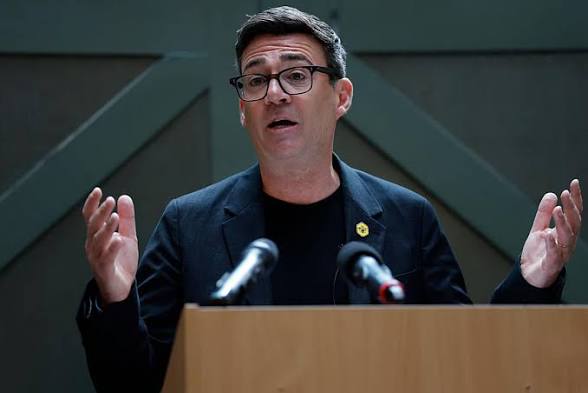
• Promises ‘No 10 North’ if he becomes PM
‘Seun Ibukun-Oni, Abuja
DAILY COURIER — Andy Burnham, the frontrunner to replace Keir Starmer as Labour leader and Prime Minister, has vowed to deliver the “biggest rebalancing of power our country has seen” through sweeping devolution away from Westminster.
Delivering his first major leadership speech at Manchester’s People’s History Museum on Monday, June 29, 2026, Burnham described Britain as “one of the most over-centralised countries in the world” and promised a “circuit breaker” for a system he said was “broken”.
The centrepiece of Burnham’s plan is a new “No 10 North” based in Manchester, which he said would be the “nerve centre of a rewired Britain”. He pledged that power and resources would be diverted from London to mayors and local authorities, with a new “devolution first” principle: powers will be held locally unless there is a fundamental need for national control.
Burnham said the Manchester base would focus on three tasks: reforming essential utilities, reindustrialisation, and the regeneration of places. He added that he would spend a significant proportion of his time there and insisted it would not be northern-centric, promising “more powers for London too, for education and housing”.
Burnham framed devolution as part of a wider 10-year mission to raise living standards after “20 years of economic decline and political failure”. On housing, he committed to the biggest council house-building programme since the post-war era, citing the loss of 1.5 million social homes since the 1980s as a driver of insecurity and rising homelessness.
On industry and jobs, he said procurement rules would be rewritten to back British businesses, manufacturing, steel, energy and food production, with public contracts used to create jobs and apprenticeships at home. For skills, he promised to put technical education on an equal footing with university routes to help the “lost generation” of young people not in education, employment or training, and to prepare them for a reindustrialised Britain.
He also unveiled plans to overhaul business rates to support pubs and high street firms, and to revive struggling town centres. On utilities, Burnham said energy and water companies would be taken under public control as part of a broader reform agenda. “We need good growth in every postcode, not concentrating wealth in London and the South East,” he said.
Burnham is currently the only declared candidate to succeed Starmer, who announced his resignation last week after two years in office amid falling popularity. If unchallenged, Burnham could be in Downing Street by mid-July.
Click on the link below to follow DAILY COURIER on WhatsApp:https://whatsapp.com/channel/0029VaAJv3FFnSz23aQ4Ab1M
Labour has rejected calls for a snap general election, with Housing Secretary Steve Reed saying the party would stick to its 2024 manifesto. The Conservatives have challenged Burnham to appear before Parliament before the summer recess to be questioned on his plans.
Analysts note fiscal constraints could limit the scale of change, with Britain’s economy under pressure from the US-Iran war and energy shocks. Critics have also questioned how budgets would be transferred and how local areas would be held accountable. Burnham argued that Westminster’s centralised model has failed: “The nation needed a ‘circuit breaker’, and for too long had been run in the interests of few rather than the many”.
If he succeeds Starmer, Burnham would become Britain’s seventh prime minister in a decade.









Tolu Bankole Mourns Former Ogun Lawmaker, Hon. Lukman Adiro

President’s Visit: Kebbi Commuters Hail Tinubu As Malando-Ngaski Road Cuts Travel Time By Half

UEFA Unanimously Backs Diallo To Oust Infantino In March 2027 FIFA Election

Top 25 Universities In Nigeria According To TIMES Ranking 2025

Nigeria Ranked Second In Africa for Catholic Population
