
Business
Dangote Refinery To Begin Nationwide Distribution Of Petrol, Diesel August 15


• Deploys 4,000 CNG tankers, offers free logistics to marketers, manufacturers, telecom firms
By Tayo Busayo, Abuja
DAILY COURIER – In what is seen as a groundbreaking intervention in Nigeria’s energy and economic landscape, Dangote Petroleum Refinery has announced it will commence nationwide distribution of Premium Motor Spirit (PMS) and diesel effective August 15, 2025.
The landmark move will see the refinery supply fuel directly to petrol marketers, dealers, manufacturers, telecommunications companies, aviation firms, and other major industrial users across Nigeria. The initiative includes free logistics support, a first-of-its-kind incentive aimed at reducing distribution costs, improving access, and stabilising fuel prices.
In a bold push to overhaul Nigeria’s fuel distribution infrastructure, the refinery has invested in 4,000 brand-new Compressed Natural Gas (CNG)-powered tankers, further supported by over 100 CNG trucks and ongoing investments in daughter booster stations to serve remote and underserved locations.
According to a statement from the company, the strategic programme is part of a broader commitment to eliminating logistics costs, enhancing energy efficiency, promoting sustainability, and supporting Nigeria’s economic development.
MORE STORIES: https://dailycourier.com.ng/nipss-expels-publisher-of-pr-nigeria/
The development is expected to revitalise dormant petrol stations, particularly in rural communities, stimulate job creation, energise Small and Medium Enterprises (SMEs), and boost government revenue, all while ensuring affordable and consistent fuel supply across the country.
Under the initiative, petrol stations and key economic sectors will enjoy direct access to Dangote’s refined products. Stakeholders eligible for fuel supply include petrol marketers and independent dealers, manufacturing industries, telecommunications companies, airlines and aviation service providers, and other large commercial fuel users.
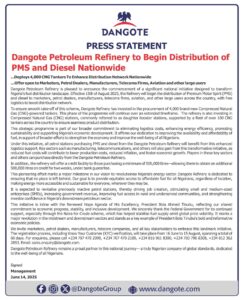
Press statement from Dangote Refinery
A credit facility is also available for bulk buyers: those who purchase a minimum of 500,000 litres will be eligible to receive an additional 500,000 litres on credit for up to two weeks, backed by a bank guarantee. This is expected to help ease operational costs in sectors where fuel constitutes a significant portion of expenditure.
The refinery has opened a 60-day registration window for interested parties, beginning June 16 and ending August 15, 2025. This process will include Know Your Customer (KYC) verification to streamline onboarding and ensure accountability. For inquiries and registration support, interested organisations may contact +234 707 470 2099, +234 707 470 2100, +234 816 961 8390, +234 703 796 8308, or +234 812 362 2893. Email enquiries should be directed to [sales.enquiry@dangote.com](mailto:sales.enquiry@dangote.com).
Follow DAILY COURIER on WhatsApp 👇 https://whatsapp.com/channel/0029VaAJv3FFnSz23aQ4Ab1M
The company praised the Federal Government for its role in supporting the venture, particularly through the Naira-for-Crude scheme, which has played a stabilising role in domestic fuel supply despite global price instability.
The refinery noted that the programme reflects the Renewed Hope Agenda of President Bola Ahmed Tinubu, especially his emphasis on economic reforms, infrastructure development, and private sector-led growth. It described the programme as a major revolution in Nigeria’s midstream and downstream sectors, and a testament to President Tinubu’s bold and reformative economic policies.
Dangote Petroleum Refinery restated its commitment to national development, equity in fuel access, and sustainability. It pledged to leave no part of the country behind, stressing that energy availability should not be a privilege but a national right. According to the company, the goal is to provide equitable access to affordable fuel for all Nigerians, regardless of location.
As preparations gear up for the August 15 launch, industry observers have hailed the move as a potential game-changer in Nigeria’s fuel economy, with the potential to reshape the structure and efficiency of the downstream oil and gas sector for years to come.




Tolu Bankole Mourns Former Ogun Lawmaker, Hon. Lukman Adiro

President’s Visit: Kebbi Commuters Hail Tinubu As Malando-Ngaski Road Cuts Travel Time By Half

UEFA Unanimously Backs Diallo To Oust Infantino In March 2027 FIFA Election

Top 25 Universities In Nigeria According To TIMES Ranking 2025

Nigeria Ranked Second In Africa for Catholic Population
